Hair Transplant Recovery: What to Expect Week by Week
Author Dr Sonali Gupta & Dr Naina Garg · 30 September 2026 · 9 min read
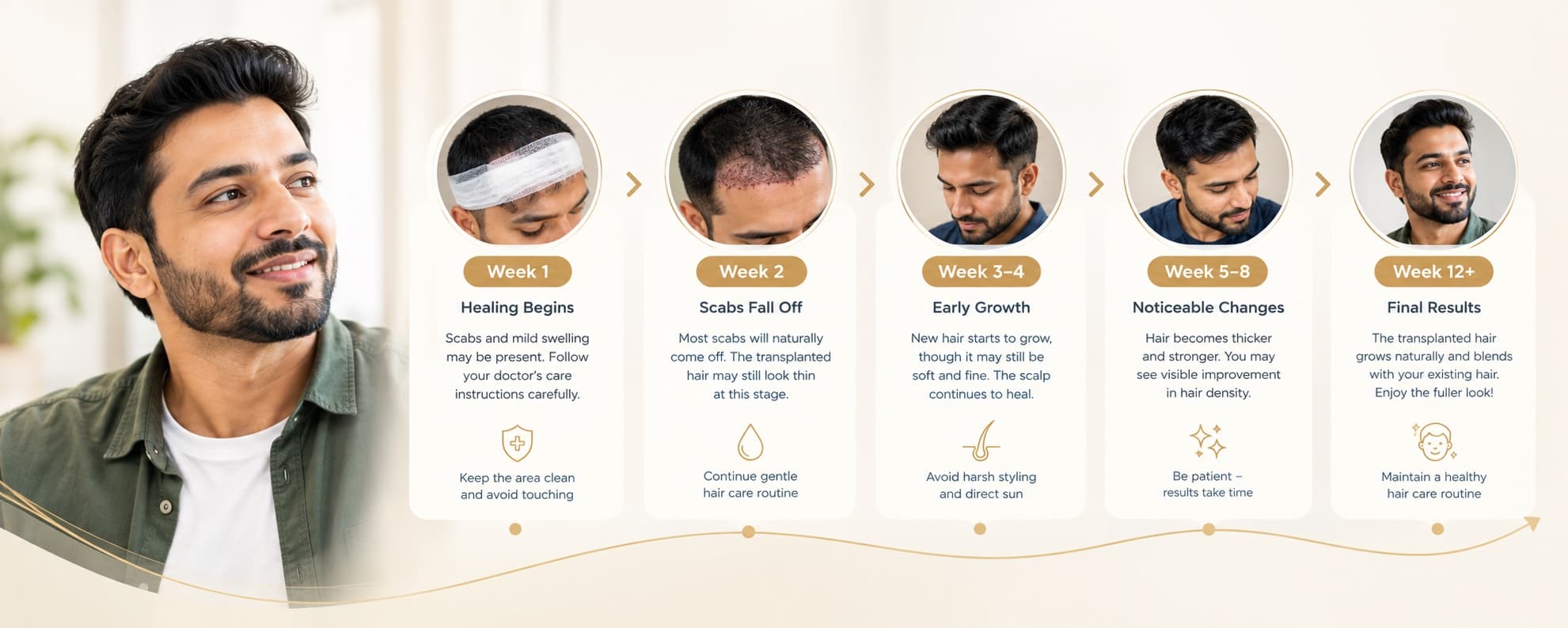
A hair transplant surgery is a major event in the life of a person with thinning or balding hair. However just like any other surgical procedure, it requires post-operative care.
The scalp needs time to heal and adapt to the changes, so it is normal for the grafted area to appear swollen, red and with a few crusts in the first weeks after the hair transplant surgery.
The information about the hair transplant aftercare week by week can help you understand what is going on with your scalp and when you can expect to see results.
Everyone heals differently and your doctor might give you particular advice depending on the type of hair transplant you have undergone.
Hair Transplant: The First Few Days
The first few days are primarily about healing and protecting the scalp and your grafts. Your scalp might be a bit red or swollen in the first few days, and you may have some small scabs around the follicles that were transplanted.
Some people also find that they are swollen around their forehead and eyes in the first few days, but it should pass with time. Your doctor will give you specific instructions regarding washing your hair, sleeping position, medication, and restriction of physical activity.
It is crucial in the first few days to avoid scratching or rubbing of the site of the transplant and touching it unnecessarily.
Week 1: After Hair Transplant
During the first week, the area where the hairs were planted may be uneven. Tiny scabs may form over the follicles of the grafted hair. The area of the donor site may be swollen and tender as well.
Hair wash generally takes place on the day of the surgery. Your doctor will tell you which type of shampoo is appropriate and how it should be applied to your donor site and transplanted areas. Do not force the grafted hairs. During this post-operative period, your grafted hairs may be short and uneven, but do not worry, they will grow in length and become thick and beautiful.
What You May See or Feel After Hair Transplant Surgery:
- Redness on the scalp
- Scabs
- Swelling
- Tightness or sensitivity
- Short hairs
- Some discomfort in the donor site
These changes can gradually improve as the scalp heals.
Week 2: After Hair Transplant
Usually, by the second week, the swelling area should be less noticeable, some scabs should start falling off on their own, and the final result may still not look like the one you desire.
During the second week after hair transplant surgery, the hairs that have grown can shed on their own.
This can be surprising for the patient, but it is a completely normal process despite the hair shaft leaving the scalp. The hair follicle underneath remains intact and prepared to grow new hair. Meanwhile make sure to take care of the scalp properly and do not pick your scabs.
Week 3 to Week 4
During weeks 3 and 4, most of the early side effects and signs of the procedure are gone.
Your scalp may look much more natural, although you still might have some swollen redness in a specific spot if you are a prone patient.
You might also start losing some of the hair that has been transplanted. This is a known shock loss or shedding after a successful transplantation.
Most importantly, you need to bear in mind that hair transplant results take time. The hair follicles that have been implanted must go through their own cycle of growth before new visible strands of hair appear. After the end of the first month, it is too early to tell the final result.
Months 2 to 3 Post-Transplant: What to Expect?
Patients who have had a transplant should not be surprised if they do not notice much new hair growth for the second and third months after the procedure.
Some of them may experience that their hair begins to shed and thin out more than it was before the transplant. But there is nothing to be afraid of since this situation is quite common and will soon take care of itself.
The inconvenience happens because the implanted follicles need some time to recover and respond appropriately. Therefore, it would be a good idea not to worry and let the process take its course.
Months 4-6: New Hair Growth
In most cases new hair growth is noticeable to patients after a few more months.
This new growth typically presents itself in the form of fine, short hairs that are often lightly colored. These hairs may thicken and darken as they grow longer.
Since each patient has varying hair growth speeds, it is common for some areas of hair loss to seem to be growing faster than others.
It is important that you continue to schedule follow up appointments with your hair transplant surgeon during this time.
In addition, you may want to ask your doctor if there are any topical or hormonal drugs that could prescribe to stimulate further hair growth.
Months 6-9: Hair Becomes Fuller
For many, this is the period when hair growth becomes more noticeable and evident at around 6-9 months post-surgery.
New strands of hair begin to appear more prominent and full. The results are already significant but not fully realized yet.
Your doctor, who will perform the hair transplant, can also confirm that everything is going well with your particular case.
Months 9 to 12 and Beyond
The end result of a hair transplant is usually not visible for several months.
Most people should see significant growth by the time they reach the nine to twelve month point, although there are some that continue to see improvement beyond this time.
The final result will depend on factors such as the number and quality of grafts performed, the patient’s characteristics and healing process, their age, genetic predisposition and the cause of their hair loss.
This is why trying to compare one’s progress to another’s should not be an indication of where you are in your own healing and growth journey.
Hair Transplant Recovery Timeline at a Glance
| Recovery Stage | What You May Notice |
|---|---|
| First few days | Redness, swelling, sensitivity and early scabs |
| Week 1 | Scabs and scalp sensitivity gradually settle |
| Week 2 | Scabs begin reducing; some hair shedding may occur |
| Weeks 3–4 | Early recovery continues; transplanted hairs may shed |
| Months 2–3 | Resting phase with limited visible growth |
| Months 4–6 | New hair growth may become more noticeable |
| Months 6–9 | Hair can gradually become thicker and fuller |
| Months 9–12+ | Hair continues maturing toward the final appearance |
Things to Avoid after Hair Transplant Surgery
The doctor gives the patient post-surgery instructions for taking care of the transplanted follicles.
So, to ensure healing is not hampered, one must avoid -
- scratching the scalp,
- picking or scratching scabs,
- intensive workouts in the first few weeks,
- putting pressure on the site with a wide range of motion,
- sun exposure,
- swimming until the doctor says it is okay,
- and using irritating products.
It all depends on the type of transplant and how the individual heals.
When Can You Go Back to Normal Activities?
Most patients are able to return to their everyday activities the day after a hair transplant, but should avoid more intense activities and those that cause lots of sweating for a while.
Your doctor will let you know when it's safe to go back to exercising, swimming, work and other activities.
It's especially important to follow these instructions during the first few days following the procedure.
When to Contact Your Doctor
Some redness, swelling, discomfort and scabbing are normal after a hair transplant surgery.
However, if you have extreme amounts of pain, swelling, bleeding, pus, fever or any other strange complications, contact your doctor immediately.
It is always better to be safe than sorry. You should inform your personal physician of any odd occurrences after your procedure rather than try to treat it yourself.
Does Hair Transplant Recover Fast?
The initial healing period is relatively short, while the entire process of growing new hair is significantly prolonged.
Although the scalp heals quickly, it is barely noticeable after several weeks, but the grafts need more time to grow thick and long hair. Thus, it is essential to consider hair transplant recovery to be a slow process.
Considering the first few weeks of healing, the entire hair restoration procedure can take months.
Hair Transplant Aftercare at SkinWin
Hair transplant is one of the skin treatments that we take special care of at SkinWin, both prior to the procedure and after.
A consultation before the hair transplant helps to identify the kind of pattern baldness you are experiencing, and what your scalp and donor hair is like in terms of suitability for the treatment. Post-op maintenance and any extra appointments are also part of the treatment.
Being informed about the hair transplant aftercare is essential if you are considering the procedure as it will give you a more realistic idea of how long the healing and growth process will take.
Frequently Asked Questions
Your scalp might require a couple of weeks to heal from the surgery, while new hair grows several months later. The results of a hair transplant are usually apparent a year after the procedure or even later in some cases.
A certain amount of shedding of the grafted hair is normal after a hair transplant. This is not an indicator of the transplant’s failure because it can simply be part of the hair-growth cycle.
It takes a few months for new hair to start growing after a hair transplant. You cannot predict precisely when the new hair will begin to grow.
Your doctor will advise you on when and how you can wash your hair. In the meantime, washing your hair is necessary but should be done gently so as not to damage the grafted hair follicles.
You can resume most moderate and mild exercises right away, but it may be necessary to avoid heavy workouts for a while after a hair transplant. Contact your doctor for specific details about resuming exercise after a hair transplant.
The results of a hair transplant usually become apparent a year after the transplant, but in any case, they become noticeable within the first year. Every individual heals at their own pace, which determines how long it takes for the grafted hair follicles to grow hair.
Final Thoughts
The healing period after hair transplantation is a long process. Be prepared that the first few months will be spent caring for the grafts and waiting for the growth to appear.
In the first weeks after the procedure, it is common to experience redness, scabs, and shedding, but then the transplanted follicles will start growing, and you will see the hair grow. Most importantly, you need to take proper post-transplant care and let the hair grow on its own.
If you are thinking of having a hair transplant, I suggest you contact professionals to make an appointment, discuss the process, desired outcome and healing time after surgery.